
Case Study
How a CrossFit Box Generated 1,000+ Appointments in 2 Years with a 6-Week Challenge Funnel
A fully-automated lead-to-booking system that ran for 2+ years and never stopped delivering
1,000+
Appointments Generated
374
Cold Leads → Appointments
747
Direct Bookings
$17.69
Cost Per Appointment
58%
Lead-to-Booking Rate
2+
Years Running
Client Overview
CrossFit & Fitness Studio
Our client is a CrossFit and fitness studio operating in the French-Canadian market. Like most gyms, they had a strong product — real results, a genuine community, and experienced coaches — but needed a consistent, scalable way to bring new members through the door without relying on word-of-mouth or seasonal promotions.
The solution was a proven, high-converting offer: the 6-Week Body Transformation Challenge, popularised by Alex Hormozi as one of the most effective client acquisition frameworks in the fitness industry. The challenge gives new prospects a low-risk, time-limited entry point — a free or low-cost transformation program — that naturally converts into long-term memberships.
The Offer
The 6-Week Challenge: Why It Works
The 6-week challenge works because it solves the gym’s biggest acquisition problem: getting someone who has never walked through the door to commit. Instead of asking a cold prospect to sign a 12-month membership, the challenge offers a defined, achievable transformation over six weeks — dramatically lowering the barrier to entry.
The psychology: Scarcity (15 spots only) + a clear outcome (body transformation in 6 weeks) + zero long-term commitment = a prospect who feels excited to apply rather than pressured to buy.
For the studio, every person who completes the challenge is a warm, loyal prospect primed to convert to a full membership. The front-end challenge acquisition cost is paid back many times over through membership revenue.
The Funnel
From Cold Scroll to Booked Consultation — Fully Automated
The entire lead-to-booking journey was mapped out, built, and automated. No manual follow-up required from the client:
Step 1 — Facebook Ad: Create Urgency and Curiosity
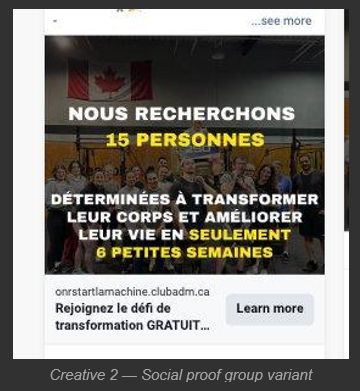
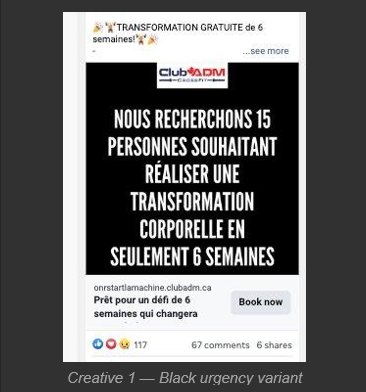
Ads ran in French targeting the local market with a bold, direct message: ‘We are looking for 15 people who want to transform their body in just 6 weeks.’ The scarcity element (15 spots) was intentional — it created urgency, implied exclusivity, and immediately filtered for serious applicants over casual browsers.
Two creative variants were tested: a high-contrast black urgency ad and a social proof group photo showing real community members. Both variants used the same core hook and call to action.
Step 2 — Lead Form & Landing Page: Capture Intent
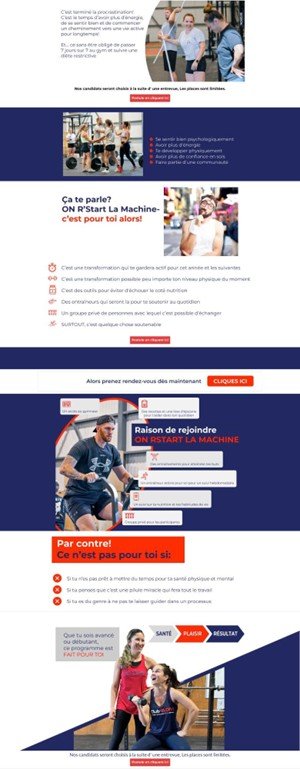
Clicking the ad brought prospects to a landing page built specifically to reinforce the 6-week challenge offer — featuring the program benefits, what to expect, what it is NOT for (filtering out uncommitted prospects), and multiple application CTAs. After reading the page, prospects filled in a lead form to ‘apply’ for the challenge.
The act of applying — rather than just signing up — further qualified intent. Someone who fills in a form to apply is meaningfully more committed than someone who drops an email into a generic opt-in box.
The 6-Week Challenge Landing Page (French-language, Quebec market):
Step 3 — Booking Page: Schedule the Consultation
After submitting the form, prospects were immediately prompted to schedule a free consultation call. This is where cold leads converted into booked appointments — and remarketing campaigns specifically targeted people who had filled in the form but had not yet booked, pushing them to complete the second step.
Step 4 — Sales Call: Close Into the Challenge
The consultation was a short, low-pressure call to understand the prospect’s goals, explain the challenge, and confirm their place. By this point, prospects had already self-selected through two steps of the funnel — the call was a confirmation, not a cold pitch.
Campaign Strategy
Two Campaigns. One Objective: Fill the Calendar.
Rather than running a single campaign and hoping for the best, the strategy used two purpose-built campaigns with different optimisation objectives — each doing a specific job in the funnel:
🧊 Cold Traffic Campaign | 🔥 Remarketing Campaign |
Objective: Website Leads | Objective: Website Schedules |
Optimised for lead form fills — maximising the volume of new prospects entering the funnel | Optimised directly for bookings — targeting warm audiences who had already engaged but not yet scheduled |
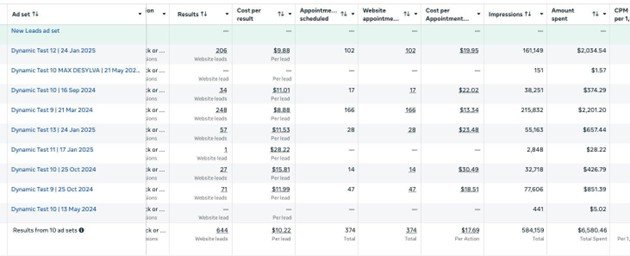
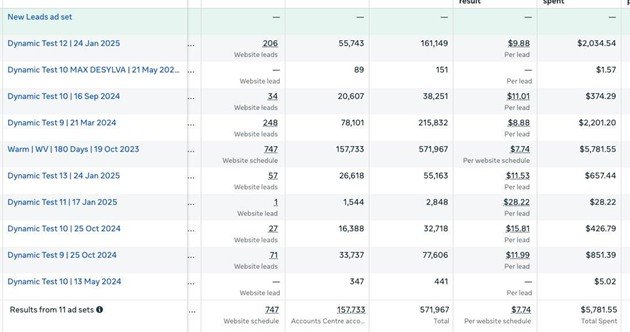
644 leads generated across 10 ad sets — 374 of those self-converted to booked appointments (58% conversion rate) | 747 appointments booked at $7.74 per booking |
Many cold leads also self-converted to appointments organically via the booking page | Retargeted website visitors, video viewers & lead form openers within 180-day window |
CPL: $10.22 | Cost Per Appointment: $17.69 | Cost Per Schedule: $7.74 |
The cold campaign filled the top of the funnel with fresh leads. The remarketing campaign followed up on warm prospects and converted them into bookings — at an even lower cost than the cold campaign CPL.
Ad Creatives
What the Winning Ads Looked Like
Both creatives ran in French targeting the local Quebec market. The core message was consistent across both: scarcity-driven, outcome-focused, and community-backed. The black urgency variant led with bold typography and a direct ask. The social proof variant used a real group photo of existing members to make the challenge feel alive and credible.
Testing both variants simultaneously meant the algorithm could quickly identify which creative drove lower-cost results for each audience segment — and budget naturally flowed toward the winner.
The Results
1,121+ Appointments. 58% Conversion Rate. Two Years Running.
The campaign ran continuously for 2+ years. From cold traffic alone, 644 leads were generated — 374 of which (58%) self-converted into booked appointments at $17.69 per appointment. The remarketing campaign added a further 747 direct bookings at just $7.74 each. Here’s the full breakdown:
Campaign | Leads / Results | Appts Booked | Cost / Appt | Spend |
Cold — Website Leads | 644 leads @ $10.22 | 374 self-converted | $17.69 | $6,580 |
Warm — Remarketing | 747 schedules @ $7.74 | 747 direct bookings | $7.74 | $5,782 |
Combined Total | 644 leads | 1,121+ appointments | ~$11 avg | $12,362 |
Cold Campaign — Lead-to-Appointment Conversion Breakdown:
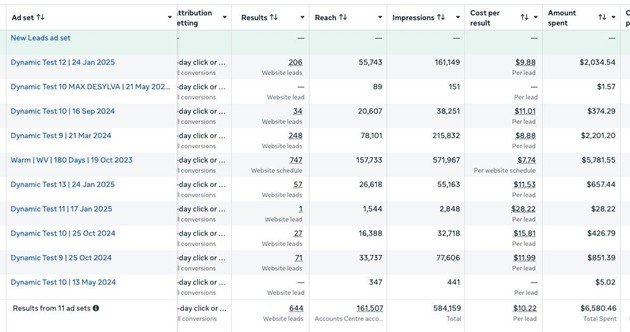
58% of cold leads self-converted into booked appointments — without any manual follow-up. The landing page and offer were doing the qualification work automatically, delivering pre-sold, high-intent prospects directly onto the calendar.
Cold Traffic Campaign — Full Ad Set Performance:
Remarketing Campaign — Direct Booking Performance:
What makes these numbers exceptional is not just the cost — it’s the consistency. The campaign ran for over two years, continuously tested and optimised through Dynamic Ad iterations, and never experienced the kind of performance collapse that kills most fitness ad accounts.
Why it lasted 2+ years
Built to Run — Not Just to Spike
Most Facebook ad campaigns for gyms burn out within weeks. Creative fatigue sets in, audiences get saturated, and costs climb until the campaign is turned off. This one ran for over two years. Here’s why:
- Dynamic Ad creative rotation: New creative variants (Dynamic Test 9 through 13) were continuously tested and rotated, keeping the campaign fresh and preventing creative fatigue from killing performance
- Separate cold and warm campaigns: By separating objectives — leads for cold, schedules for warm — each campaign was optimised for exactly what it was supposed to do, rather than one campaign trying to serve two masters
- 180-day remarketing window: The warm audience campaign cast a wide enough net to always have enough prospects to retarget, even as new cold leads cycled through
- Audience refresh through lookalikes: As the customer base grew, new lookalike audiences were continuously generated from real customer data — keeping cold targeting sharp and relevant
- Offer durability: The 6-week challenge is a timeless mechanism. It does not go out of style, because the desire for a body transformation never goes out of style
Key Takeaway
What Made This System Work
- The 6-week challenge converts because it reduces commitment: A defined, time-limited program is far easier to say yes to than an open-ended gym membership — especially for prospects who have failed at fitness before.
- Scarcity and specificity drive quality leads: ’15 spots’ + ‘6 weeks’ + ‘body transformation’ in the ad copy pre-qualified intent before anyone clicked. The people who applied actually wanted to show up.
- Split your funnel objectives: Cold traffic optimised for leads, warm traffic optimised for bookings. Two campaigns, two objectives, dramatically better results than one campaign trying to do both.
- Remarketing is where the ROI lives: The warm campaign generated appointments at $7.74 — cheaper than cold leads — because it targeted people already interested. Always retarget your engaged audiences.
- Creative rotation is the engine: Dynamic Ad testing kept the account alive for 2+ years. Without continuous creative refresh, the campaign would have burned out in months.
- Longevity is the ultimate proof: A campaign that runs profitably for two years is not luck. It’s a validated system — and a validated system is the most powerful asset an agency can deliver for a client.
Want a system like this for your fitness clients?
We build and run the complete 6-week challenge funnel — ads, copy, lead forms, booking automation — so your clients get a steady flow of new members on autopilot.